Just a few years ago, a standard power bank with a capacity of 10000 mAh was fully sufficient for most users. Today, however, we use many mobile devices at the same time – smartphones, tablets, wireless earbuds, or laptops. As a result, demand is growing for a power bank with a higher capacity.
Table of Contents
Power bank capacity: why is the demand for energy growing?
Users are increasingly choosing models that offer high capacity and high charging power. Power banks with capacities of 30,000 or 50,000 mAh are available on the market, allowing you to charge not only a phone, but also a laptop or several devices at the same time. Such solutions work especially well during travel, mobile work, or field trips.


20,000 mAh or 30,000 mAh power bank: how many mAh do you really need?
Today, power banks are used for more than just charging smartphones. Depending on their capacity and charging parameters, they can also power tablets, wireless earbuds, smartwatches, handheld consoles, and, in the case of models with higher output power and Power Delivery technology, also laptops with a USB-C port.
That is why choosing the right power bank capacity depends primarily on which devices we want to charge with it and how often we plan to use it.
| Power bank use case | Recommended capacity |
|---|---|
| Topping up a smartphone during the day | 10,000 mAh |
| Charging a phone several times or charging several mobile devices | 20,000 mAh |
| Travel and charging several devices at the same time | 20,000–30,000 mAh |
| Powering a laptop, phone and mobile accessories | 20,000–30,000 mAh with Power Delivery |
Power banks with a capacity of around 20,000 mAh are becoming some of the most versatile solutions. They allow you to charge a smartphone several times, and thanks to a greater number of USB ports, they also often make it possible to charge several devices at the same time, such as a phone, wireless earbuds, or a smartwatch.
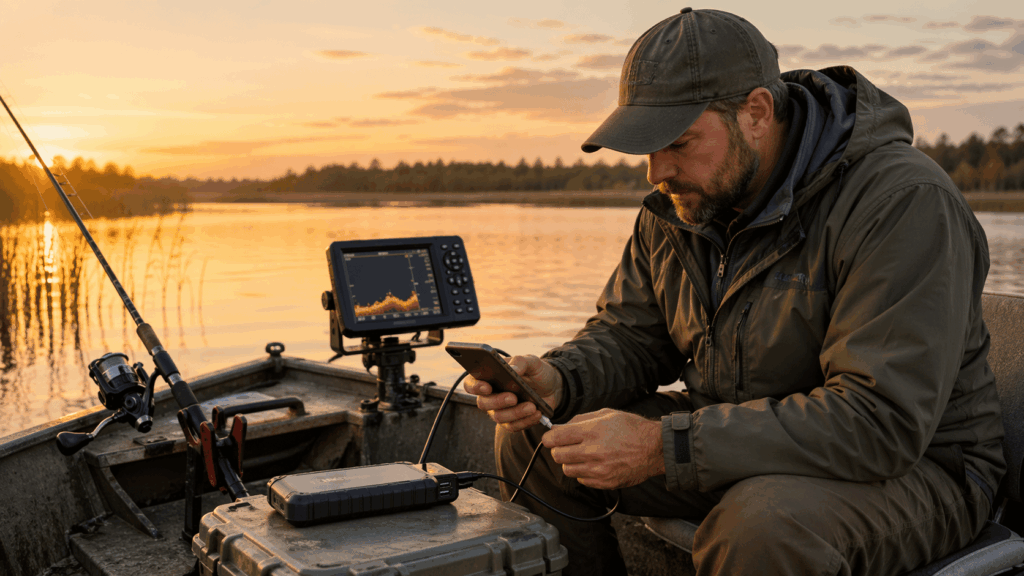
Power bank over 20,000 mAh for field work and outdoor activities
Large power banks make particular sense wherever mobile devices serve not only a communication function, but also a navigation and organizational one. This applies, among others, to anglers, sailors, participants in mountain, trekking, and off-road expeditions, as well as other people working without постоян access to a power source.
In such conditions, a power bank with a capacity of 20,000 mAh or more can power not only a smartphone, but also handheld GPS devices, satellite communicators, tablets with maps, outdoor watches, action cameras, or USB-rechargeable flashlights.
The longer the user remains away from base, network coverage, and a power outlet, the more important not only the capacity of the power bank becomes, but also a real energy reserve for equipment that helps with navigation, orientation in the field, and maintaining communication.
Charging laptops: when does a power bank really make sense?
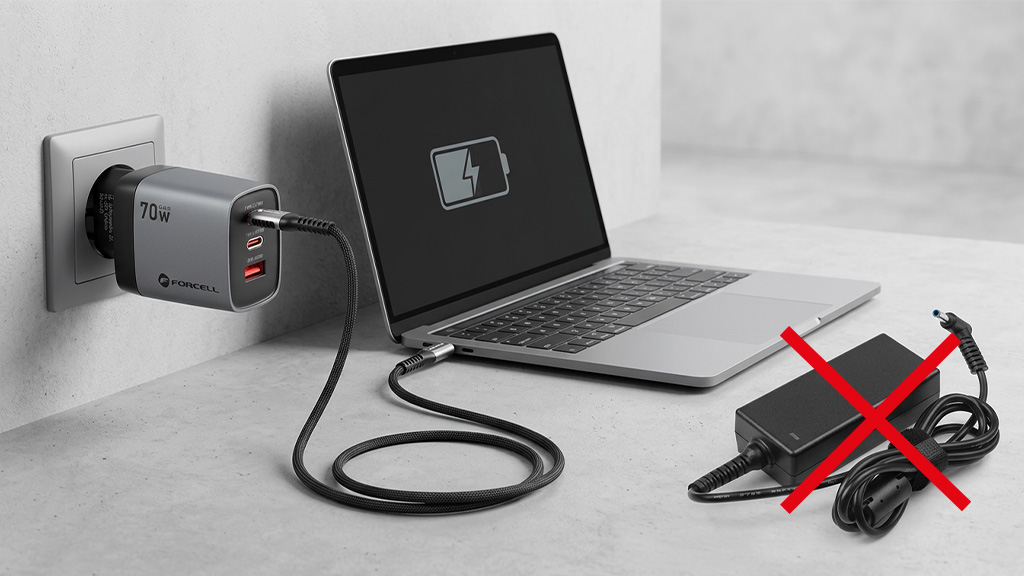
With the widespread adoption of the USB-C connector, more and more power banks can charge not only smartphones, but also laptops. What matters most here is support for Power Delivery (PD) technology and the right charging power – in practice at least 45–65 W, and for more demanding models even 100 W. This kind of solution works especially well in situations where access to a power outlet is limited.
A power bank with USB-C PD can easily charge an ultrabook such as a MacBook Air, Dell XPS, Lenovo ThinkPad, or ASUS ZenBook, as well as a tablet or smartphone. That is why a USB-C laptop power bank is becoming a practical solution both for mobile work and while travelling. That is also why it is increasingly seen not only as an emergency power source for a phone, but as mobile power for an entire set of devices.
Power Delivery and Quick Charge: fast charging standards in modern power banks
Modern power banks use various fast charging technologies that reduce the time needed to recharge energy. The most important of these are Power Delivery technology and Quick Charge fast charging.
Power Delivery charging automatically adjusts the voltage and current to the connected device. Thanks to this, it works well both for smartphones and for charging laptops or tablets.
In turn, Quick Charge fast charging allows compatible phones to charge much faster. A good example of a compact device that supports fast charging is the Hoco Q37 10000 mAh. This model offers power of up to 22.5 W, making it possible to charge smartphones quickly in everyday use.
USB ports and output power: how many devices can a power bank charge at the same time?
In modern power banks, we increasingly see multiple output ports, most often in the form of USB-A and USB-C. It is the number of ports and their output power that determine how many devices can be powered at the same time.
A power bank equipped with two or three USB ports allows you to charge several devices at once – for example a smartphone, tablet, and wireless earbuds. In many models, the USB-C port is responsible for faster charging of devices with higher power requirements, such as a tablet or laptop, while USB-A ports are used to charge phones or smaller accessories.
A good example of such a solution is the Veger T65A power bank with a capacity of 20,000 mAh, which offers three output ports – two USB-C ports and one USB-A port. The device supports Power Delivery technology with output of up to 65 W as well as Quick Charge 3.0, so it can power both smartphones and more demanding devices, including USB-C laptops such as the MacBook Pro. At the same time, it allows you to charge up to three devices at once.
It is worth remembering, however, that when several devices are charged at the same time, the power bank’s output power is shared between the ports. This means that the more devices we connect, the lower the maximum power available to each of them may be.

Power bank on a plane: capacity restrictions
Many people wonder whether a 50000 mAh power bank can be taken on a plane. Airlines do not define limits in milliampere-hours (mAh), but in watt-hours (Wh), which show the actual amount of energy stored in the battery. This value can be easily calculated using the following formula:
Wh = (mAh × battery voltage) / 1000
Most power banks use cells with a voltage of 3.7 V, so example calculations are as follows:
- 20,000 mAh → approx. 74 Wh
- 27,000 mAh → approx. 99 Wh
- 50,000 mAh → approx. 185 Wh
According to the guidelines of aviation organizations (IATA), power banks up to 100 Wh can be carried in hand luggage without additional airline approval. Devices with a capacity of 100–160 Wh may require carrier approval, while batteries exceeding 160 Wh are, in most cases, not allowed on board an aircraft.
In practice, this means that popular models with a capacity of 20,000 mAh, such as the Veger T65A power bank (74 Wh), can be taken on a plane without any problem. By contrast, a 50,000 mAh power bank usually exceeds the energy limit and will not be accepted for transport by many airlines.

Standards and certifications used in power banks
These restrictions are primarily due to safety concerns. The media regularly report cases of power banks overheating or catching fire on board aircraft, most often caused by battery damage or the use of low-quality devices. That is why, when choosing a power bank, it is worth paying attention not only to its capacity, but also to its safety certifications.
Power banks distributed by Partner Tele.com hold, among others, the following certifications:
- CE – confirming that the product complies with EU safety standards
- RoHS – relating to the restriction of hazardous substances in electronics
- MSDS – battery safety documentation
- UN38.3 – confirming compliance with transport requirements for lithium batteries
This gives users confidence that they are using a device that meets the required safety standards, which is especially important during air travel.

FAQ: power bank on a plane
Can you take a 50000 mAh power bank on a plane?
In most cases, no. A power bank with a capacity of 50,000 mAh has around 185 Wh, which exceeds the permitted limit of 160 Wh specified in air transport regulations.
What power bank can you take on a plane?
In most cases, power banks with a capacity of up to 100 Wh are allowed, which usually means around 20,000–27,000 mAh. Such devices can be carried in hand luggage without needing airline approval.
Can a power bank be packed in checked baggage?
No. Power banks with lithium-ion batteries must be carried only in hand luggage, because in the event of a failure, the crew can react quickly.
Do power bank certifications matter when travelling by plane?
Yes, because they confirm that the lithium battery used in the power bank meets specific safety standards and has been tested for transport.
Documents such as UN38.3 confirm that the battery has passed the tests required for lithium batteries in transport, while MSDS contains information about the properties and safety of the materials used in the battery. This means that the power bank meets the safety standards used in the logistics and distribution of devices with lithium batteries.
LCD display or LED indicators: how can you check the power level in a power bank?
Information about the power level in a power bank can be displayed in different ways. The simplest solution is LED indicators, which show the approximate battery charge level, usually in several steps – for example 25%, 50%, 75%, and 100%.
More and more often, however, manufacturers use digital displays that show the exact power level as a percentage. This allows the user to easily check how much energy is left in the power bank and better control the charging time of mobile devices.
An example of such a solution is the power bank Hoco J151A with a capacity of 20,000 mAh, equipped with a digital LED display showing the power level as a percentage. This solution makes it possible to monitor the battery status precisely and makes it easier to plan charging while travelling or working on the go.
Wireless power bank and MagSafe: when is it worth it?
In recent years, models offering wireless charging. Such a wireless power bank allows you to charge a smartphone without having to connect a cable.
Some models also offer the option of wireless charging in the MagSafe standard, which is especially appreciated by users of modern iPhones.
Power bank ranking 2026: examples of popular models
In the ranking of the best power banks of 2026, models with a capacity of 20,000 mAh are often highlighted. However, battery size is not the only criterion – charging power, charging time, and the option of wireless charging also matter.
The ranking is topped by the popular Ugreen PB205 25000mAh model, which delivers more than 100 W of power even when all ports are in use. Similar solutions are also offered by power banks available from Partner Tele.com wholesale, but at slightly lower prices. We especially recommend the Veger T100 with a capacity of 20,000 mAh, which uses a well-regarded lithium-polymer battery known for its slower self-discharge. The Veger C20 20000 mAh with built-in cables is also worth choosing, as are Hoco models equipped with digital energy level displays.
How to choose a good power bank for everyday use?
When choosing a good power bank, it is worth paying attention to a few key parameters:
- power bank capacity,
- supported charging standards,
- number of USB ports,
- maximum power.
For everyday use, models with a capacity of 10000 or 20000 mAh are often sufficient, while for intensive mobile work, devices offering high capacity and the ability to charge several devices at the same time are a better choice.
Ultimately, the answer to the question of which power bank to choose depends primarily on the number of devices and how they are used.
Are large power banks the future of mobile power?
The growing number of devices using the same USB-C standard is making power banks an increasingly universal source of energy. Depending on their capacity, charging power, and number of ports, they can power not only smartphones, but also tablets, wireless earbuds, or laptops. That is why the choice of the right model increasingly depends on how many devices we want to charge and in what situations we use mobile power – while travelling, working in the field, or during everyday use.
Power banks in the Partner Tele.com offer
At Partner Tele.com wholesale, a wide selection of power banks is available for different applications – from compact models for everyday smartphone charging to higher-capacity devices that can power several devices at the same time.
The offer includes both power banks from the company’s own brands, Forcell and Blue Star, as well as popular models from manufacturers such as Hoco and Veger, offering fast charging, multiple USB ports, and practical solutions such as built-in cables or digital energy level displays.

Patrycja Blechinger_Partner Tele.com
Author and editor specializing in new technologies, e‑commerce and B2B/B2C communication. At Partner Tele.com, she develops educational and SEO content for the GSM accessories, consumer electronics and online sales sectors, combining editorial expertise with hands‑on experience in content marketing.
She has extensive experience in marketing, PR and sales. She has worked on communication campaigns, collaborated with PR agencies and created a wide range of content – from articles and industry publications to brand materials and advertising copy. This allows her to combine technological knowledge with a practical understanding of market and customer needs.
She focuses on topics related to modern technologies – from 3D printing and scanning to automation, e‑commerce and consumer electronics. She is the author of industry publications for Polski Przemysł, where she wrote about additive manufacturing and technological solutions for the industrial sector.
At Partner Tele.com, she also co‑creates communication for brand blogs, including Hoco and Forcell. She is currently expanding her knowledge in psychology, which supports her approach to audience analysis and creating content tailored to customer behavior.